Language matters: why how we talk about unmet need for contraception counts
Why do 214 million women who want to avoid pregnancy not use modern contraception? How we describe unmet need shapes the programmes we design.
Access or use?
Research by the Guttmacher Institute, Adding It Up (2017), shows that 214 million women of reproductive age in developing regions want to avoid pregnancy but aren’t using modern contraception. They are not seeing the many benefits of contraception for their health and wellbeing as well as for their families and societies.
The language used to describe unmet need is vital. Here, unmet need isn’t framed as the number of women who want to avoid pregnancy but ‘cannot access’ contraception, or are ‘denied access’ to contraception. Instead, it’s simply the number of women who aren’t using contraception. And that’s for a range of reasons.
Understanding the reasons for unmet demand
Why does it matter how we talk about unmet need? To satisfy unmet demand, we need to understand why women aren’t using contraception even though they don’t want to become pregnant.
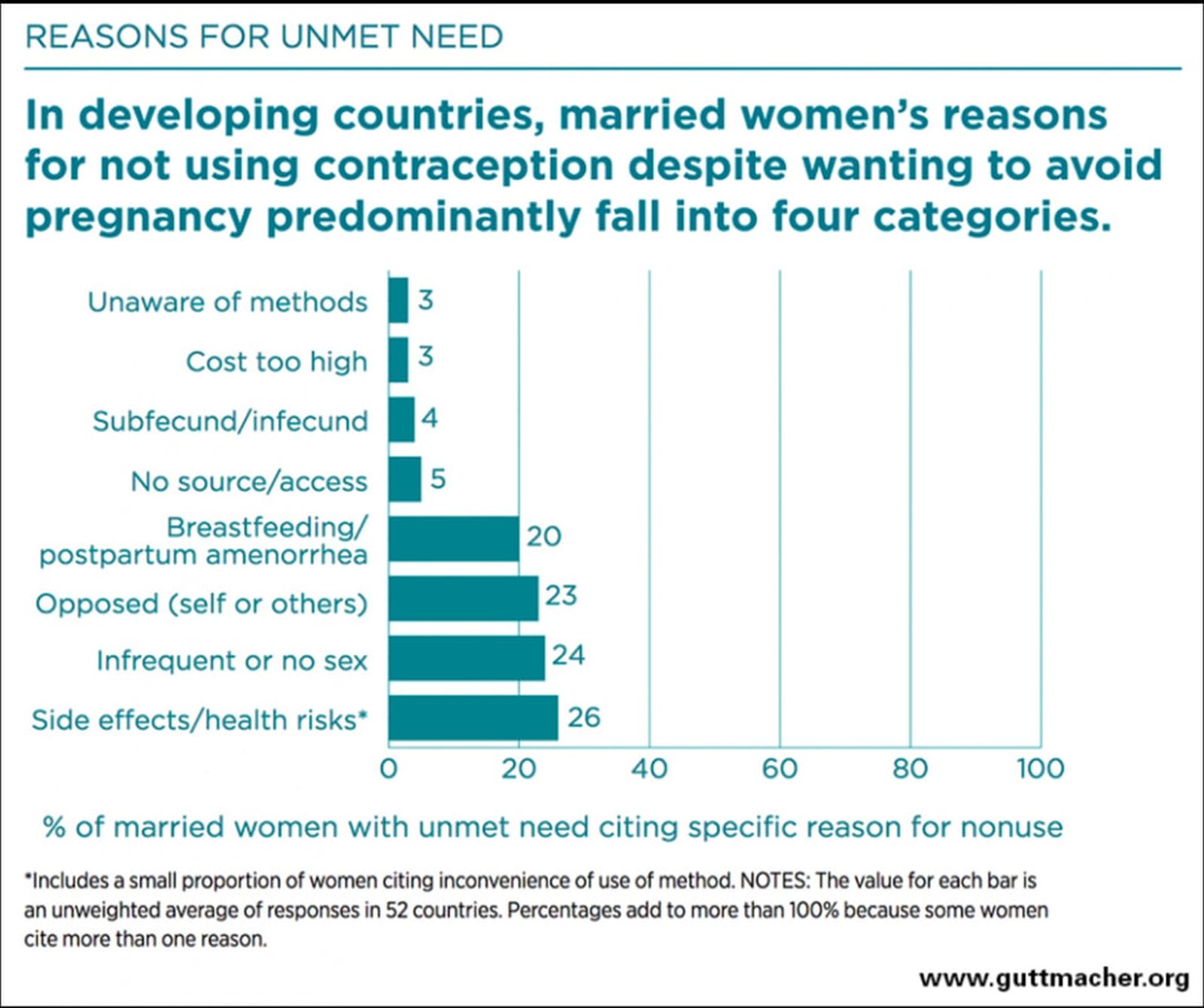
The reality is complex and it’s about more than just access. Indeed, when asked, women rarely cite limited access to family planning as the reason why. The top reasons women give are:
concerns about the side effects of contraceptive methods;
infrequent sex;
they or others oppose contraception;
they don’t think they have to use contraception when they are breastfeeding.
Capturing this complexity isn’t easy in a short, punchy sentence, but we do need to make sure that our messaging is nuanced.
Meeting women’s and girls’ needs
Access to rights-based contraception is essential. This means ensuring the availability of contraceptives; strengthening supply chains to avoid stock-outs; and delivering affordable services to marginalised, hard-to-reach groups, including adolescents, and in humanitarian settings.
But programmes must also ensure acceptability and quality of care. Dissatisfaction among family planning users – leading to discontinuation – is a major challenge. A study in 34 countries found that more than a third of women (38%) who were using a family planning method discontinued within 12 months.
To ensure family planning programmes are effective, evidence-informed, and meet women’s and girls’ needs, we must listen to what women are saying. This means that programmes must:
Improve quality of care: offering a method mix and counselling to expand contraceptive choice, reduce discontinuation and address women’s concerns about side effects.
Deliver information and education (including rights-based comprehensive sexuality education for young people in and out of school) to raise awareness of the risk of pregnancy from infrequent sex and when women are breastfeeding.
Empower women, increase women’s and girls’ knowledge of their rights, and engage men, boys, community and religious leaders to challenge gender norms and overcome opposition to contraception.
To accelerate progress in meeting unmet demand for contraception and help women and girls to exercise control over their own bodies, we need to ensure that not only are programmes evidence-informed but also that our messaging is accurate.